


Executive Summary
A stroke department in an NHS district general hospital evaluated ECG On-Demand’s Hybrid patch service as an alternative to the current Holter pathway within the Trust, run by the cardiology department.
ECG monitoring post-stroke is critical for the detection of atrial fibrillation (AF), a major preventable cause of ischaemic stroke. Despite its importance, the current pathway experiences long delays and missed diagnostic opportunities.
Key Findings:
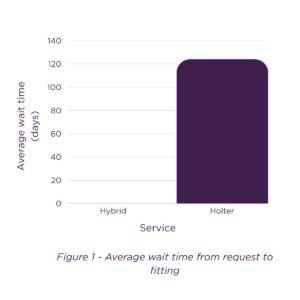
- There was a dramatic reduction in waiting time from monitoring request to fitting appointment. In the hybrid arm, patients were fitted with their monitor on the same day whereas the Holter arm experienced an average of 124 days wait for their appointment.
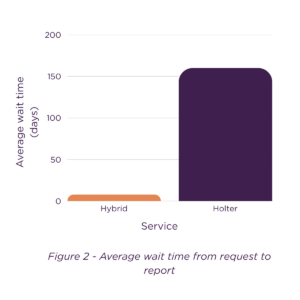
- Request to report turnaround times were also drastically reduced in the hybrid arm with an average turnaround time of 8 days versus an average turnaround time of 160 days in the Holter arm.
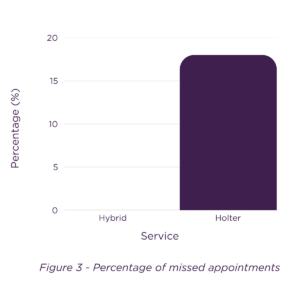
- 100 % of patients in the hybrid arm received long term ECG monitoring whereas 18% of patients in the Holter arm did not have their monitoring request fulfilled.
- ECG On-Demand’s hybrid service benefits from monitor return via Royal Mail, eliminating unnecessary hospital appointments, reducing burden on the patient and freeing up clinical time.
- The hybrid arm also benefitted from ECG On-Demand’s traffic light triage system therefore, urgent cases were escalated immediately, resulting in rapid intervention.
- The streamlined service in the hybrid arm reduced operational strain and delivered measurable savings across both the stroke and cardiology services.
Conclusion
The hybrid service pilot study demonstrated a clear clinical, patient-centred and operational benefit when compared to the current Holter service.
The hybrid service and its technology could be transformative for stroke and TIA pathways by ensuring timely diagnosis, improved access and reduced systemic efficiencies. This report supports wider adoption within the stroke network and beyond.
Introduction
Continuous ECG monitoring is an important part of the management of patients with transient ischaemic attacks and ischaemic strokes, particularly for the detection of atrial fibrillation (AF). AF is the cause of approximately 20% of ischaemic strokes. AF related strokes are associated with worse clinical outcomes and higher mortality compared to non-AF strokes(1). Undiagnosed AF can lead to recurrent strokes therefore early diagnosis is important in this group.
The pilot study aimed to demonstrate how innovative technology can transform the current stroke/cardiac monitoring pathway to reduce diagnostic delays, improve accessibility and deliver a more efficient and patient centred experience – the hallmarks of a modern healthcare system.
To achieve this, the stroke team implemented ECG On-Demand’s hybrid patch service. This allowed patients to be fitted with an ECG patch monitor during their TIA appointment or on discharge from the hyper acute stroke unit (HASU), eliminating unnecessary waiting times. After the monitoring period, the patch monitors were returned to ECG On-Demand by post, removing the need for additional appointments. As a result, the burden on patients’ time was reduced and valuable clinical time was also freed up.
ECG On-Demand’s service includes the traffic light triage system that was integrated into the stroke team’s follow up process.
Urgent cases such as clinically significant arrhythmias (e.g. AF or complete heart block) were escalated immediately to the requesting clinician by email, resulting in rapid intervention.
Results
The results showed a striking contrast between the two services (Hybrid and current pathway).
Time from monitor request to monitor fitting
In the hybrid arm of the pilot, every patient was fitted with an ECG patch monitor on the day of their request, effectively leading to no delay. In contrast, the Holter arm saw patients wait an average of 124 days from request to monitor fitting. This prolonged waiting period represents the major barrier to timely diagnosis. This is illustrated in figure 1.
Time from monitor request to report
The turnaround times from request to report also favoured the hybrid service.
In the hybrid arm, there was an average of 8 days from request to report with urgent cases being immediately escalated. This resulted in earlier detection of AF and faster initiation of pharmacological treatment. In contrast, patients in the Holter arm experienced an average wait of 160 days from request to report (figure 2), increasing risk due to long intervals between stroke/TIA occurrence and screening for AF.
Missed appointments
Missed appointments were also evaluated (figure 3). In the hybrid arm of the pilot, 100% of patients attended their appointments. In the Holter arm, 18% (35 out of 199) of Holter monitoring requests were never fulfilled. The reasons for this were:
- A patient death prior to appointment
- Patients moving to another service/geographical area
- Patients not attending appointments
- Patient declining appointments.
The reasons stated above highlight some of the consequences of long waiting times. The hybrid service eliminates the need for another appointment.
Cost and resource savings
The Hybrid service pilot not only demonstrated improvements in clinical outcomes and patient experience, it also highlighted cost and resource savings. Monitoring and reporting came at a unit cost of £130 (for 5 days of recording), within the NHS national payment scheme tariff (EY51Z) of £135.
Reduced appointment burden: Postal return eliminated the need for follow up visits thus saving outpatient clinic times and associated administrative costs.
Lower risk of missed diagnosis: 100% completion of monitoring requests using the hybrid service reduces the likelihood of recurrent strokes caused by undetected AF that carry high treatment costs and prolonged hospital stays.
Streamlined workflow: Same day fitting and rapid reporting minimised delays, reduced inpatient bed occupancy and freed up staff resources.
Avoidance of systemic waste: 18% of appointments in the Holter arm were missed, which represents wasted scheduling and resource allocation. The same day fitting in the hybrid arm avoids this wastage.
Conclusion
The hybrid service pilot demonstrates substantial clinical and operational advantages compared to the current Holter pathway.
Same day monitor fitting ensured universal access and postal return reduced the need for further hospital appointments. Patient experience was also improved.
The request to report turnaround for the hybrid arm was 8 days, with urgent findings escalated immediately through a robust triage process.
Using the hybrid service, no patients were denied monitoring, in contrast to the current Holter pathway in which systemic delays led to 18% of patients missing out on monitoring.
All the above lead to cost savings throughout the stroke and cardiac pathways within the Trust.
References:
Elsheikh S, Hill A, Irving G, Lip G, Abdul-Rahim AH. Atrial Fibrillation and Stroke: State-of-the-art and future directions. Current Problems in Cardiology [Internet]. 2023 Oct 1 [cited 2026 May 12];49(1):102181–1. Available from: https://www.sciencedirect.com/science/article/pii/S0146280623005984